
Interview with Thies Falko Pithan and Hanna Feuser
We speak with Thies Falko Pithan, Head of the Materials Engineering/New Materials Division at the Kunststoff-Institut Lüdenscheid (KIMW) and Hanna Feuser, Project Manager at Kunststoff-Institut für die mittelständische Wirtschaft NRW GmbH (KIMW), about the goals and benefits of the new collaborative project “Recycling 3”, as well as about its content and approach.
Background on the “Recycling 3” Project
The industry project “Recycling 3” of the Kunststoff-Institut Lüdenscheid with BKV GmbH started on September 16 with a kick-off meeting. The project focuses on the use of post-consumer recycled materials (PCR), regulatory requirements, available recycled materials, as well as material flows and recovery pathways in the plastics circular economy. The goal of the project is to establish a practice-oriented knowledge platform for the use of post-consumer recycled materials (PCR) in plastics processing.
The groundwork was laid by the predecessor projects “Recycling 1” and “Recycling 2,” in which the KIMW carried out a systematic analysis of post-consumer waste (PCR) and established a comprehensive recycled material database containing approximately 2,000 materials. Building on this, the “Recycling 3” project is now launching in cooperation with BKV GmbH to advance the industrial use of recycled materials.
The Kunststoff-Institut Lüdenscheid
The Kunststoff-Institut Lüdenscheid founded in 1988 by entrepreneurs from the South Westphalia region, the institute acts as a service provider and supports companies in the selection, development, and implementation of products, tools, and processes in the field of plastics technology. It operates its own technical center as well as numerous facilities for testing materials, components, and surfaces. The focus is on injection-molded parts made from thermoplastics and thermosets. As a bridge between science and practice, the institute primarily supports small and medium-sized enterprises in improving the quality, efficiency, and sustainability of their products and processes, as well as in adapting them to new product developments and requirements.
Our Interview Partners
Thies Falko Pithan:
In 2015, after completing his degree in mechanical engineering and subsequently conducting research at the South Westphalia University of Applied Sciences, Thies Falko Pithan joined the Department of Materials Engineering/New Materials at the Kunststoff-Institut Lüdenscheid. Since 2021, he has headed the Department of Materials Engineering/New Materials and leads the current collaborative project “Recycling 3.”
Hanna Feuser:
Hanna Feuser has been an employee at KIMW since January 1, 2021. In her role as project manager, Ms. Feuser has already led several industrial projects in the field of recycling and the use of recycled materials and is also active in the funded project “Future Materials Forum” which is testing concepts to promote the circular economy for plastics. Ms. Feuser is applying the experience gained from the “Future Materials Forum” to the currently ongoing collaborative project “Recycling 3.” Hanna Feuser earned her master’s degree in Materials Science and Sustainability Methods from the Bonn-Rhein-Sieg University of Applied Sciences.
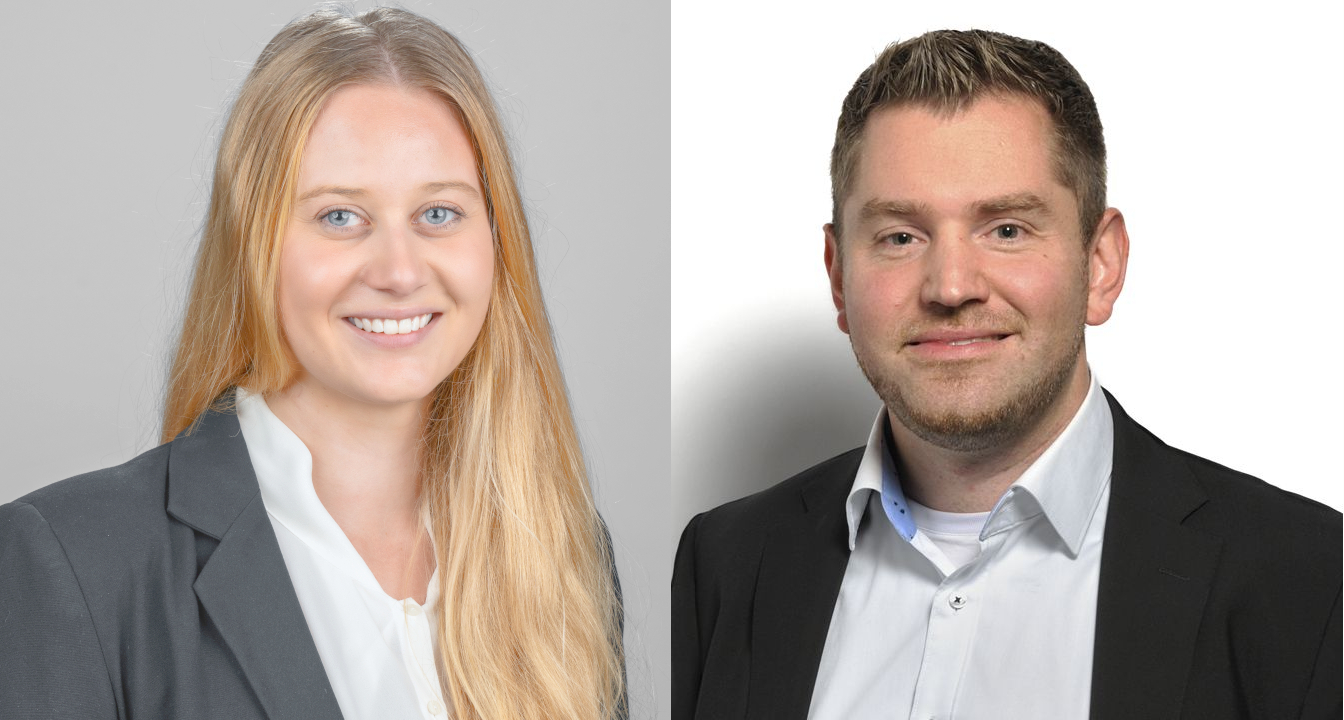
| Thies Falko Pithan (right in the photo) & Hanna Feuser (left) on their collaboration with BKV GmbH in the “Recycling 3” project: |
“Through this collaboration, we can specifically combine our respective areas of expertise. Above all, we are united by the strong practical focus of our projects and our shared goal of developing results that offer companies concrete added value and can be directly applied in operational practice.” |
You’ve brought BKV GmbH on board as a partner for the new collaborative project “Recycling 3.” To what extent does BKV’s expertise complement the project’s objectives? Which aspects—both in terms of content and concept—are particularly important to you?
BKV GmbH has extensive expertise in the field of the plastics circular economy, particularly with regard to regulatory requirements, available waste streams, and their recycling pathways. The insights and experience gained from numerous BKV studies therefore complement the planned knowledge platform in the “Recycling 3” project very well.
Through this collaboration, we can strategically combine our respective areas of expertise. Above all, we are united by the strong practical focus of our projects and the shared goal of developing results that offer companies concrete added value and can be directly applied in operational practice.
How do the insights from “Recycling 1” and “Recycling 2” help you with the new collaborative project?
Plastics recycling has evolved from the initial production of single-type recyclates in accordance with quality specifications for post-consumer plastics to recyclates tailored for specific end-product applications. Plastics recycling is now approached by working backward from the end product—that is, the end application—to determine the appropriate processing inputs, the necessary sorting steps, and the specific preparation methods. The necessary quality assurance measures are implemented at every stage, from the waste stage all the way to the end product.
In the predecessor projects “Recycling 1” and “Recycling 2,” we systematically examined recyclates from various waste streams and evaluated them in terms of their quality. In doing so, we were able to gain valuable experience in the methodological characterization of post-consumer recycled materials and gain comprehensive insight into the market for available recycled materials.
With “Recycling 3,” we are now taking it a step further and linking the findings from practical material analyses with the technical, regulatory, and market-related requirements of the plastics circular economy.
Processors and users today face major challenges due to stricter requirements under waste management regulations such as the European Packaging Directive (PPWR) and the EU End-of-Life Vehicles Regulation (ELVR). How do you assess these requirements for the stakeholders involved? What do you expect in terms of future material and product development?
Regulatory requirements pose major challenges for the plastics processing industry. In particular, the minimum content requirements for recycled materials are demanding, as post-consumer recycled materials must be available in sufficient quantities and with material quality that is as consistent and reliable as possible.
To ensure a long-term supply of high-quality recycled materials, the concept of “Design for Recycling” must be given greater consideration as early as the product development stage. At the same time, material requirements should be critically examined and, where the application permits, adjusted to facilitate the use of secondary raw materials.
Since the positive effects of products designed for recycling often only become apparent over the long term, recycling technologies and material development must also be advanced in parallel.
| Thies Falko Pithan & Hanna Feuser on the importance of “Design for Recycling” for the use of recycled materials: |
"To ensure a long-term supply of high-quality recycled materials, the concept of ‘Design for Recycling’ must be given greater consideration as early as the product development stage. At the same time, material requirements should be critically examined and, where the application allows, adjusted to facilitate the use of secondary raw materials." |
How does the “Recycling 3” project specifically help a typical small-to-medium-sized enterprise (SME) navigate the balancing act between legal requirements, technical feasibility, and remaining competitive?
With “Recycling 3,” we aim to provide companies with guidance in the increasingly complex plastics circular economy. SMEs, in particular, often lack the personnel and time resources to deal intensively with all regulatory, technical, and market-related developments.
Our goal is therefore to present relevant knowledge in a practical and understandable way and to provide companies with a well-founded overview of current and future requirements with as little effort on their part as possible. In addition, we aim to provide concrete recommendations for action and guidelines that serve as a basis for strategic decisions and practical implementation.
Individual questions can then be explored in greater depth through bilateral collaboration based on the project results.
A key research focus in “Recycling 3” is odor reduction and emission minimization in post-consumer recycled materials. What technical approaches or new additive technologies are you investigating to develop PCR materials that are also suitable for sensitive interior applications—such as in the automotive sector or in household appliances?
There are various points of intervention along the recycling process for reducing unwanted odors and emissions. In the project, we are focusing on measures that we can specifically influence during material processing.
One focus is on the use of different additive systems during compounding. In addition, we are investigating thermal cleaning and post-treatment processes that can be applied before or after pelletization.
Our goal is to determine which odor-causing impurities can be most effectively reduced by which additives and thermal treatments—including in combination. From this, we aim to derive practical recommendations to improve the material quality of post-consumer recyclates and expand their potential uses, even for more demanding applications.
If you look ahead two years and the project ends in August 2028: What do you hope to have achieved so that “Recycling 3” was a complete success for you and the participating companies?
For us, the project would be a complete success if we were not only able to provide the participating companies with new insights and a well-founded overview of developments in the plastics circular economy, but also offer concrete ideas and/or assistance for implementation in their day-to-day operations. It is crucial to us that the insights gained provide sustainable added value for the companies beyond the project’s duration.
Ms. Feuser, Mr. Pithan, thank you very much for the interview!
(October 2026, Photos: © Sichtbahr, Michael Bahr, Kunststoff-Institut Lüdenscheid)